Buellton Agricultural Land Water and Access Essentials
If you are looking at agricultural land around Buellton, the view is only part of the story. Water, legal access, zoning, and parcel history can shape whether a property works for a vineyard, ranch use, or a future improvement plan. A clear grasp of those basics can help you avoid costly surprises and move through due diligence with more confidence. Let’s dive in.
One of the first questions to answer is whether the parcel is inside Buellton city limits or in unincorporated Santa Barbara County. That line matters because the City of Buellton handles planning and code enforcement within the city, while Santa Barbara County is the main authority for zoning, permitting, and subdivision rules outside city limits.
Buellton’s land use framework also makes clear that the city’s limits, Urban Growth Boundary, and Sphere of Influence help define where city rules apply. The Urban Growth Boundary is intended to limit premature conversion of agricultural, watershed, and open-space land, which is especially relevant if you are evaluating a parcel at the edge of town.
For buyers, this is not a technical detail to skip. Jurisdiction affects what records you pull first, which approvals may apply, and how realistic your plans are for access, wells, building, or future parcel changes.
Before you focus on planting plans or building concepts, verify the property’s basic records. Santa Barbara County points buyers to parcel detail tools, zoning lookups, permit history, and surveyor maps, which are some of the first places to confirm what the land is and how it has been handled over time.
This step can reveal issues that are easy to miss in a marketing package. A parcel may look straightforward on a map, but prior permits, easements, restrictions, or old survey conditions can affect how you use it.
For rural and agricultural land near Buellton, early record review should include:
In this area, agricultural preserve status can be a major part of the property story. Santa Barbara County’s Agricultural Preserve Program is designed for long-term conservation of agricultural and open-space lands, and the Assessor’s Williamson Act questionnaire for contract holders shows that preserve status is an ongoing compliance matter.
That means you should not treat preserve status as just a label on a flyer. If land is under preserve contract, future plans involving lot-line adjustments or boundary changes may require extra review.
County rules note that on agricultural-zoned parcels under preserve contract, lot-line adjustments require added findings, including no net decrease in restricted acreage and continued agricultural viability. In practical terms, boundary changes, access easements, and future split strategies may face a more detailed process than you expect.
Rural property often comes with normal agricultural impacts that may feel unfamiliar if you are coming from an urban or suburban setting. Santa Barbara County maintains a Right-to-Farm resource that highlights conditions such as dust, equipment traffic, odors, sprays, and other ordinary farming activity.
This matters in the Buellton area because surrounding lands are part of a broader agricultural landscape. If your goal is a quiet country holding with vineyard or ranch potential, it is wise to understand that active agricultural operations nearby are part of the setting, not an exception to it.
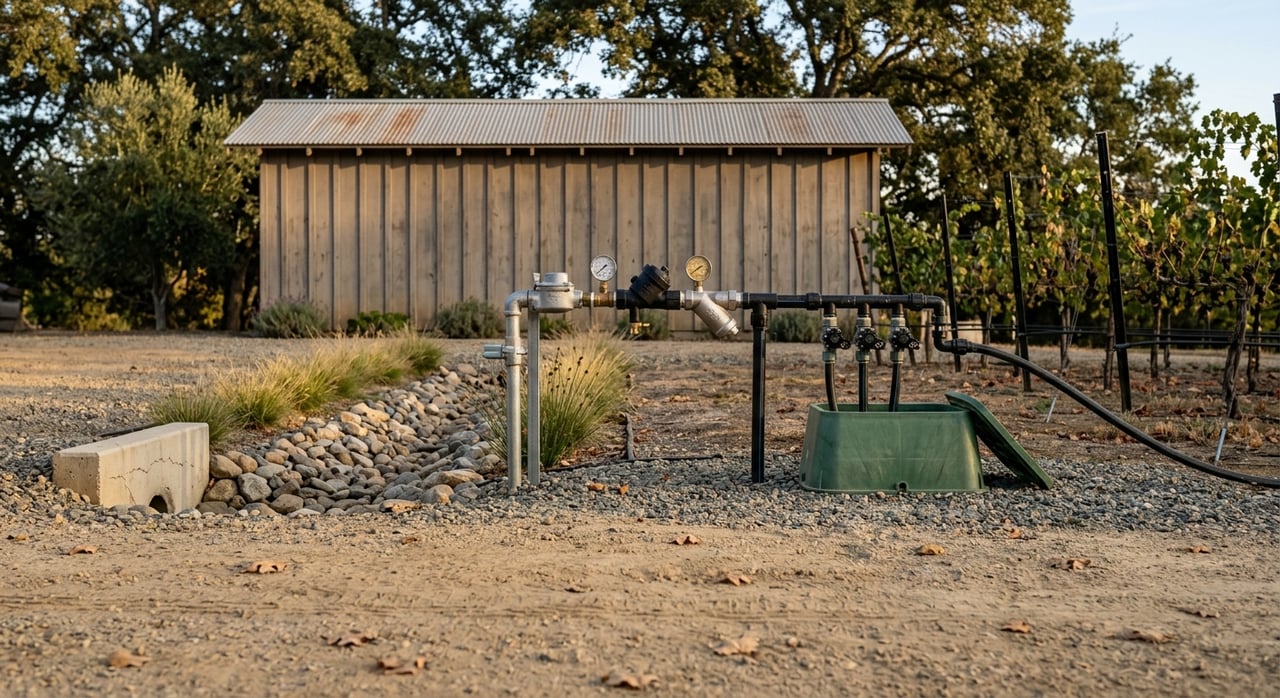
For Buellton agricultural land, water is one of the first operational questions to answer. If the parcel is on city service, the City of Buellton reports that its water supply comes from groundwater supplemented by the State Water Project, with sources including the Buellton Uplands Groundwater Basin and the Santa Ynez River Underflow.
The city reports four supply wells, two irrigation-only wells, and one State Water Project turnout. It also notes that the Santa Ynez River Underflow permit is 1,385 acre-feet per year, while the Buellton Uplands source has no current pumping permit restriction.
Even so, available supply is not just about paper capacity. The city warns that drought, facility constraints, and storage limitations can reduce realistically available supply, and that is an important reminder for any buyer evaluating a property’s real-world utility.
Buellton-area parcels are tied to the Central Management Area of the Santa Ynez River Valley Groundwater Basin. The basin is managed through Western, Central, and Eastern areas, each with its own Groundwater Sustainability Agency structure.
For buyers considering a new well, a replacement well, or redevelopment tied to groundwater, this is a key checkpoint. In the Central Management Area, you should review the current well-permit verification process before you assume drilling timelines or costs.
If the property is not served by an existing water system, county subdivision rules require an adequate potable water supply. For small water systems, County Public Health may require well locations, contamination setbacks, well logs, construction plans, water-quality testing, storage plans, engineer or geologist reports, and service-area mapping showing the basin can support the development.
The county also requires written notice that a private water supply is at the purchaser’s own risk and expense when no community water system is provided. That makes documentation critical, especially on ranch and vineyard parcels where seller descriptions may sound stronger than the paper trail behind them.
For a Buellton-area agricultural property, it is smart to ask for:
A workable water source is only one piece of the picture. County water-supply rules show that a small system may also need waterworks plans, storage facilities, line sizing, treatment or disinfection methods, and cross-connection controls.
If you are evaluating a vineyard or ranch parcel, you should verify whether the property has a functional well or district connection, adequate storage, reliable pumping capacity, distribution mains, and any backflow or cross-connection controls. These are the practical details that affect whether irrigation and day-to-day operations are feasible.
It is also worth noting what not to assume. Buellton reports that recycled-water service is not currently cost-effective citywide, so you should not count on a future reclaimed-water line or irrigation source unless it is clearly documented.
On rural land, water questions rarely stand alone. County sewage rules also look at lot size, usable area, topography, groundwater depth, soil and rock structure, and percolation tests.
That means water, septic, and buildability are closely linked. A parcel may be attractive on acreage alone, but slope, soil, groundwater conditions, or usable building area can change what is practical for a home site, agricultural support structures, or expanded operations.
A beautiful parcel can become complicated very quickly if access is not clear. County subdivision rules require legal access to a public road or right-of-way easement, and an existing private road must meet applicable fire-agency roadway standards.
This is one of the most important early checks for agricultural land. If access depends on easements, shared roads, or frontage improvements, you want to know exactly what rights exist and what standards may apply before you commit.
County rules also say reserve strips controlling access generally will not be approved. That reinforces the importance of reviewing the legal and physical access picture, not just assuming the current driveway tells the whole story.
Some Buellton-area parcels have frontage near a state highway or rely on improvements close to state right-of-way. In those cases, Caltrans requires an encroachment permit for activities in, under, or over the state highway right-of-way.
That can affect plans for new driveways, road widening, utility work, or other access improvements. If a parcel’s future value depends on changing how you enter or serve the site, this checkpoint deserves early attention.
County review standards for lot-line adjustments and special treatment areas go beyond maps and water reports. They also consider water supply, sewage disposal, access, slope stability, agricultural viability, environmental sensitivity, hazard review, and consistency with county planning and zoning rules.
Special treatment area rules also recognize fire, flood, erosion, slope, and other terrain-related issues on sensitive rural land. In the Buellton area, those factors can directly affect whether a site is practical to improve, insure, irrigate, or safely access year-round.
When you are looking at Buellton agricultural land, order matters. A disciplined review process can save time, protect capital, and help you focus on parcels that truly fit your goals.
A sensible sequence is:
This order follows the city-county jurisdiction split and the county’s water and access requirements. It also gives you a practical framework for deciding whether a property supports your intended use before you spend heavily on design or operating assumptions.
Buellton-area land can offer real opportunity, but the value of a parcel is tied to more than acreage and location. The most useful questions are often the quiet ones: Who has jurisdiction? Is preserve status in play? Is the water source documented and adequate? Is access legal, recorded, and usable under current standards?
When you answer those questions early, you can evaluate a property more clearly and negotiate from a stronger position. That is especially important for vineyards, ranches, and larger rural holdings where infrastructure and regulatory details often shape long-term value.
If you are evaluating a Buellton parcel and want experienced guidance on land, water, access, and the broader transaction strategy, Murphy Atkinson offers confidential advisory support rooted in Santa Ynez Valley agricultural property expertise.
leisure
Wine Tasting
Santa Ynez Lifestyle

leisure

leisure
Santa Ynez Lifestyle
Santa Ynez Lifestyle

AVA
leisure
Immerse yourself in a realm where expertise meets empathy, transactions transform into relationships, and dreams find their home in the heart of California's scenic grandeur.